Travel textiles · Practical guide
How to Choose a Travel Pillow for Better Neck Support
A useful travel pillow does more than soften a seat or fill a gap behind the head. It helps steady the neck in the position you can actually rest in, while remaining comfortable to carry, use, and clean. Shape, filling, cover, and fit all matter—and the best choice depends on how you travel and how you sleep.
Published October 10, 2026
At a window seat, the world slides past in fragments: a runway, a band of cloud, the dark outline of hills at dusk. Yet the body experiences the journey less cinematically. A head tips forward. A shoulder tightens. The neck searches for a position that a fixed seat rarely provides. Hours later, arrival may bring stiff muscles rather than the feeling of having rested.
A travel pillow can help, but it is not a universal remedy. A tall cushion that feels supportive in a shop may push the head forward against an aircraft headrest. A soft pillow may feel pleasant at first but collapse when weight settles on it. A bulky design may be comfortable enough to use yet awkward to carry through a station or pack into a day bag. Choosing well means thinking about the way you sit, the direction your head tends to fall, and the practical realities of the trip.
The central question is not simply which pillow is softest. It is whether its shape and filling provide useful support in your usual resting position without creating new pressure points. The following guide explains how to compare travel pillows for planes, trains, and road trips—and what to check before bringing one along.
Start with the way you rest
Travelers do not all fall asleep in the same way. Some lean toward a window; others nod forward or tilt their heads back. Some remain upright, while others recline as far as a seat allows. The pillow that works for one posture may be uncomfortable for another, so notice what your head naturally does when you become tired.
If your head tends to fall sideways, look for a shape that supports the side of the neck and limits the distance the head can drift. A contoured neck pillow can provide a supportive boundary around the neck, though its height and firmness should suit your seat and body. If your head falls forward, a conventional U-shaped cushion may not prevent that movement on its own. A design with a secure closure can help keep the pillow in place, but it still needs to feel comfortable without pressing the chin or throat.
Travel posture also changes with the setting. An aircraft seat may have a headrest that already provides some support; a bus seat may be more upright; a car passenger may have more room to shift position during breaks. On a train, a traveler might lean against a window or use a compact pillow behind the head. Consider where you will rest, how much space you will have, and whether the pillow needs to serve more than one purpose.
Before a long trip, try the pillow while sitting in a chair with a similar angle to your travel seat. Wear the clothes you expect to travel in and test the closure, if there is one. A short trial can reveal whether the cushion pushes your head forward, rubs against your jaw, or leaves an uncomfortable gap. This simple check is more useful than judging a pillow only by how it feels while standing.
Shape: support is a matter of fit
Travel pillows come in several broad forms. U-shaped neck cushions wrap around the sides and back of the neck. Contoured designs may provide firmer support in selected areas. Compact rectangular pillows can be placed behind the neck, against a window, or between the body and a seat. Each format solves a different problem, and none guarantees comfort for every traveler.
A U-shaped pillow is familiar and easy to position, but its usefulness depends on proportion. If it is too thick for the space between your neck and seat, it can push your head into an awkward angle. If it is too soft or narrow, it may provide little resistance when the head begins to tilt. A contoured pillow may feel more structured, while a simple rectangular style gives the user more flexibility in where to place it. That flexibility can be valuable on trains or during road trips, but it may require more adjustment.
Check how the pillow fits around the shoulders as well as the neck. A cushion that sits too high can lift the head; one that is too low may leave the head unsupported. The goal is not to immobilize the neck, but to make a relaxed position easier to maintain. Support should feel steady rather than forceful.
Closure details can affect fit. A clip or fastening may help hold a neck pillow in place and make it easier to carry, but it should not create pressure or interfere with movement. Try fastening it loosely first. Make sure it can be released easily and that its position works with collars, scarves, or other layers worn during travel.
Filling: firmness, rebound, and temperature
The filling shapes how a pillow responds when your head rests against it. Memory foam is used in some contoured neck pillows because it forms a shaped cushion that can feel more structured than a loosely filled pillow. Its comfort is personal: a firm, shaped support may suit someone who wants a stable boundary, while another traveler may prefer a softer, more yielding feel.
Other travel pillows use fiber fills or a combination of materials. These may feel lighter or more flexible, and some can be compressed for packing. But a pillow that compresses easily may not keep its shape under prolonged pressure. Check whether the fill is described clearly, and consider whether the pillow is intended to support the neck, cushion the head, or provide a softer surface for resting.
Warmth matters in enclosed travel spaces. Cabin temperatures and ventilation can vary, and a pillow held close to the neck may feel warmer than expected. A breathable outer fabric can make the contact surface more comfortable, but the experience depends on the complete construction, including the filling and how closely the pillow wraps around the body. If you tend to overheat, prioritize a cover that feels comfortable against the skin and avoid assuming that a particular fiber alone will control temperature.
Weight and packability belong in the same decision. A substantial cushion may offer a stable feel but take up more room. A compressible or compact option may fit easily into a carry-on, but it should still provide enough support for your intended use. Think about the whole route: a pillow carried through transfers and crowded platforms needs to be manageable before the journey begins.
The cover is part of the experience
The outer fabric is the surface that meets the skin, hair, and clothing for hours. Smooth textiles can feel gentle, while a fabric with more texture may feel secure or familiar. Neither quality is automatically better; comfort depends on personal preference, the climate, and whether the pillow will be used over a shirt or directly against the skin.
Silk is one option for a travel pillow’s outer shell. For example, the Silk Travel Neck Pillow in Pink and Ivory Stripe combines a 100% mulberry silk shell with a memory foam cushion. It has a clip closure and a removable cover, features that may be useful for travelers seeking a smooth contact surface and a cover they can take off for care. Its listed dimensions are 12 by 12 by 4 inches; checking those measurements against your own packing space and seat is sensible before a trip.
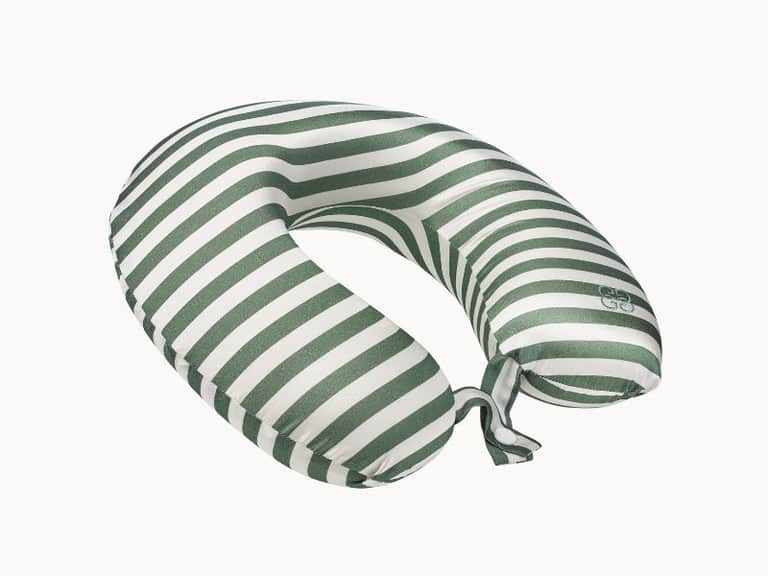
A similar construction is found in the Silk Travel Neck Pillow in Green and Ivory Stripe, which pairs a mulberry silk shell with memory foam and includes a clip closure and removable cover. These details describe materials and design—not a guarantee that the shape will suit every neck or seating position. As with any travel pillow, consider whether its height, contour, and firmness feel right for you.
For any cover, inspect the seams and closure. Seams that sit against a sensitive area can become noticeable over a long journey. A zipper or fastening should be easy to operate, but should not leave sharp or bulky parts against the skin. If the cover is removable, check whether the care instructions are straightforward and whether the filling itself has separate cleaning requirements.
Removable covers and the realities of care
A pillow travels through a changing environment: a seat, a luggage compartment, a hotel room, perhaps a car or train on the return journey. A removable cover makes it easier to refresh the surface between uses, provided it can be washed according to its instructions. It can also help protect the cushion from everyday contact, though it does not eliminate the need to keep the pillow clean and dry.
Read care directions before buying, not after a spill. Some covers may be machine-washable on a delicate cycle; others may require a particular detergent, low temperatures, or air drying. The cushion or filling may need spot cleaning or professional care. Do not assume that a washable cover means the entire pillow can be immersed, tumble-dried, or cleaned in the same way. Follow the instructions for each component.
When packing, allow a damp or freshly washed cover to dry fully before placing it in a bag. Store the pillow in a clean, breathable compartment when possible, and avoid crushing shaped foam for long periods if the care guidance advises against it. A dedicated pouch can keep the pillow separate from shoes, toiletries, or other items that may soil the fabric.
Good care is not only about appearance. A clean, dry surface is more pleasant to use repeatedly, and a pillow that retains its shape is more likely to remain comfortable. A clear care label and removable cover can therefore be practical features, especially for frequent travelers who use the same pillow across several trips.
Match the pillow to the journey
For air travel, consider the seat’s headrest, the length of the flight, and how much room you have around your shoulders. A compact neck pillow with a closure may be convenient when you want a stable cushion that stays near the body. If you usually lean toward the window, a rectangular pillow might be more adaptable, though it may not remain in position as easily during movement.
On trains, passengers often have more freedom to shift posture, but the available support can vary from one seat to another. A versatile pillow that can be placed behind the head or neck may be useful. For long-distance bus journeys, a contoured design may appeal to travelers seeking a more defined support surface, while a secure fit can help when the seat offers little room to reposition.
Road trips bring a different consideration: a passenger may be able to adjust the seat or take breaks, but a pillow should never interfere with a seat belt or safe positioning. Keep the driver’s movement and visibility unobstructed, and use rest stops to stretch rather than expecting a pillow to compensate for hours of fixed posture. In any vehicle, safety comes before comfort accessories.
For a short journey, carrying a larger pillow may not be worthwhile. For an overnight trip, a more structured design and a removable cover may justify the space it occupies. Make the decision based on the route and your own habits rather than on a generic claim that one shape is best for every kind of travel.
A practical comparison checklist
Product descriptions can make several designs sound alike. A short checklist helps separate the details that matter from decorative language:
- Resting position: Does your head usually tilt sideways, forward, or toward a window?
- Shape and height: Will the pillow fit between your neck and the seat without pushing your head into an uncomfortable angle?
- Filling: Is the cushion memory foam, fiber fill, or a blend, and does that construction match your preference for firmness and flexibility?
- Cover: Does the surface feel comfortable, and are seams and fastenings positioned away from pressure points?
- Cleaning: Is the cover removable, and are the instructions for both cover and filling clear?
- Portability: Can you carry or pack the pillow without it becoming a burden during transfers?
- Trial fit: Have you tested it while seated in a position similar to the one you expect on the journey?
These questions will not predict every moment of comfort. Travel conditions change, and a pillow that feels right at home may behave differently in a narrow seat. But they make comparisons more grounded and reduce the chance of choosing a design for appearance alone.
What a travel pillow can—and cannot—do
A travel pillow can provide a surface to rest against and may help limit unwanted head movement. It cannot replace a well-adjusted seat, regular movement on a long journey, or professional advice about persistent pain. Neck discomfort has many possible causes, and no textile accessory can promise to prevent injury or treat a medical condition.
If a pillow creates pain, numbness, pressure, or a feeling that your head is being forced into position, remove or adjust it. People with existing neck or spinal concerns may want to ask a qualified health professional what kinds of support are appropriate for them. The aim is a comfortable resting position, not a rigid hold.
It is also worth remembering that rest comes from more than equipment. A change in posture, a short walk when safe and permitted, gentle movement, and sensible planning for breaks can all make a long trip more manageable. A pillow is one tool among several—not a substitute for listening to the body.
Choose for the traveler you are
The best travel pillow is not necessarily the largest, firmest, or most elaborate. It is the one whose shape meets your usual resting position, whose filling feels supportive without being intrusive, and whose cover and care routine suit the way you travel. For one person that may mean a compact contoured cushion; for another, a flexible rectangular pillow that can move from neck to window.
Pay attention to the small details: dimensions, filling, closure, removable cover, and cleaning instructions. Try the pillow in a seated position before relying on it for an overnight journey. If you are comparing silk-covered options, treat the fabric as one part of the construction rather than a substitute for checking fit and support.
Journeys unfold in cramped cabins, rattling carriages, and the changing light beyond a window. A thoughtfully chosen pillow cannot make every seat spacious or every trip quiet. It can, however, make it easier to settle into a comfortable position—and that modest advantage can matter when the miles are long.